/media/3447900/noakessydgc2024-min-river.jpg)
Min River (DH)
NSW
- Sail number
- AUS888
- Type
- Jpk10.30
- Owner
- Jiang Lin

/media/3450036/navigators-2.jpg)
In the lead up to a big offshore sailing race, weather and navigational chat around the docks can become overwhelming.
Who’s right? Who’s wrong? Will competitors head offshore or stay inshore?
To get the real dirt, ahead of this Saturday’s Noakes Sydney Gold Coast Yacht Race (NSGCYR), NSGCYR Media sat down with two highly experienced and respected navigators, Steve Taylor and Alex Nolan.
Taylor is on board Rob Aldis’ Mylius 50 Daguet 2. In his early-30s, Taylor has achieved huge success as a navigator. In the 2024 Rolex Sydney Hobart Yacht Race (RSHYR), Taylor was instrumental in the JPK 11.80 Cocody (FRA) claiming first in its division by a margin of 17 hours and 13 minutes. And in last year’s NSGCYR, he navigated the ES 44 Tempo to third Overall and first in IRC Division 0.
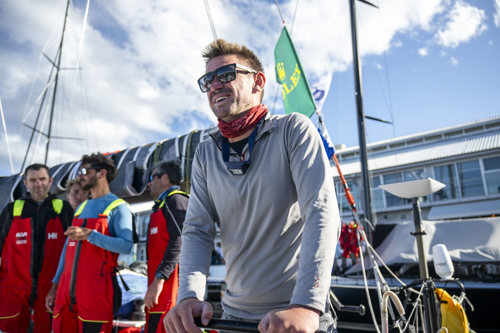
Steve Taylor on board Cocody after they finished the 2024 RSHYR. Image: CYCA | Ashley Dart
Alex Nolan, on board Ronal Epstein’s JPK 11.80 Bacchanal (USA), also has impressive credentials. He joins the minority of sailors who have won the Rolex Sydney Hobart Yacht Race on both Line Honours and Overall – in 2021 on board Peter Harburg’s Reichel/Pugh 100 Black Jack (Line Honours) and in 2024 on board Sam Haynes’ Volvo 70 Celestial V70 (Overall). His next challenge? To navigate a much smaller (39 feet), almost new yacht to Overall victory in the 2025 NSGCYR.
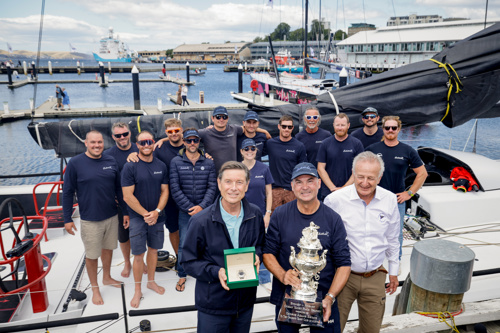
Alex Nolan (second from the left) and the Celestial V70 crew. Image: Salty Dingo
As a navigator, tell me about your initial thoughts on the forecast so far?
Steve: The initial wind models that came through last weekend were looking quite strong. But now it looks like we’ll probably sail in some pre-frontal* conditions for at least a couple of hours of the race.
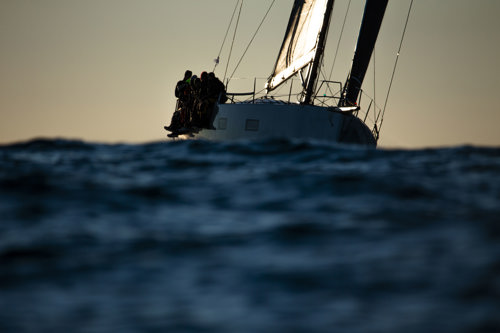
Daguet 2 sailing towards the 2024 NSGCYR finish line. Image: CYCA | Ashley Dart
The pre-frontal conditions are more northerly winds. That’s going to generate a big sea state. We’re looking at least two and a half meters of sea state for the first 12 to 16 hours of the race.
Hopefully, by about 1600 hours or 1700 hours on the Saturday, that front will have passed and the gradient* westerly winds will be behind it. That’ll work to progressively flatten out the sea. The wind will then settle down to around 18-25 knots and will remain fairly stable for the rest of the race.
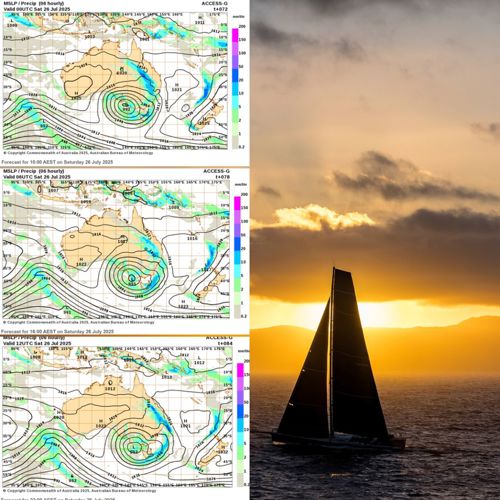
Figures 1 – 3 show mean sea level pressure (MSLP) and predicted rainfall of the low pressure system and associated front moving across the racecourse from 1000hrs, 1600hrs, 2200hrs.
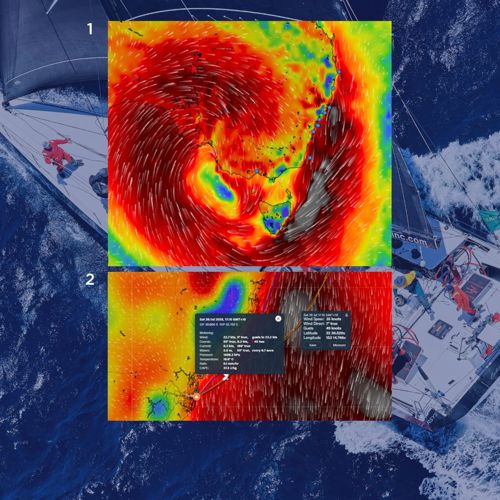
Steve: Figures 1 & 2 (above image) show the UK model predicting significant wind gusts of 40-52 knots on the frontal compression, all models agree there will be significant wind gusts at lower latitudes (Bass Strait & Tasmanian Coast) however begin to misalign on the northern extent of the front. These compression gusts are often hard to predict as an exact figure and I make a habit of expecting more, rather than less. The UK model predicts significant wind gusts over the race course until just after 1700hrs.
Alex: I think it’s going to be an interesting race for the navigators with a split between an inshore and offshore course. The wind looks like it’s tending to favour the offshore, which is not a traditional play for this race. There will be a bit less wind inshore with the sheltering effect from the headlands.
So, we’ve got a few decisions ahead of us, to decide on an inshore or an offshore route. Especially the smaller boats, where the current has more of an impact.
How do you avoid the current in this race?
Steve: For a race like the NSGCYR, you’re pushing current for quite a lot of the race if you get it wrong.
Often, you’ll find most current relief inshore. What’s the trade-off? Sailing in lighter breeze but no current [inshore] or sailing in slightly stronger breeze but pushing current [offshore].
That’s the balance we’re trying to weigh up.
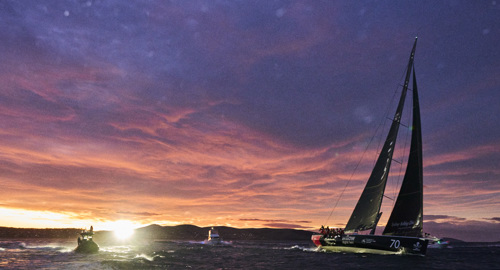
Celestial V70 heading to the 2024 RSHYR finish line. Image: ROLEX/ Carlo Borlenghi
Other challenges to keep in mind as a navigator for the NSGCYR?
Steve: The changes between day and night – the diurnal* wind cycles where land breeze becomes more stable at night and fluctuates throughout the daytime.
How does being a navigator on board Daguet 2 differ to being the navigator on board TP52s and Tempo?
Steve: The boat itself, it’s a carbon fibre cruiser racer. It’s around about four tons heavier than a TP52. So, there’s some considerations in that as well.
I’ve been the navigator on many TP52s, and you can sail a longer distance on them because the boats are so fast. It’s a definite risk going offshore because you have to cross fast moving currents to get outside the currents. And then you have got to cross back through the current to get back into the Gold Coast. With the weather routing systems that we have now, we’re able to quantify basically how much extra time it’s going to cost us to get out wide, if there’s any sort of payoff to being out there.
The last two Noakes Sydney Gold Coast Yacht Races on Tempo, we went out quite wide and that paid big dividends in the long run. We won the division both years. But it’s definitely a risk. Two years ago we were the only ones that went that wide.
You’ve navigated on some amazing boats including Blackjack, Celestial (TP52) and Celestial V70. How does Bacchanal differ?
Alex: It’s a smaller group of people. So, you’re more involved on the boat side of things rather than just the navigation, and you spend more time together because it’s a bit slower. That’s an interesting challenge. It’s a different end of the spectrum, which is quite nice.
What does your roster look like? And are you just navigating?
Alex: I’ll help a little bit when needed. I generally just navigate, but again, that’s going to be a bit different on this boat with less people.
I sort of play my time around the weather and the radio SKEDS* and the crunch points of the race where you want to make sure you’re aware of what’s going on.
What’s an example of a ‘crunch point’?
Alex: There are some corners in this race that get rocky if you’re in close (e.g. Seal Rocks). The big one will be whether we go inshore or offshore.
Daguet 2 is a pretty flash boat, is the navigation station comfortable?
Steve: The software and the hardware in the navigation station is top of the range, but it’s a bit lacking in terms of a seat down there. So not comfortable for me, but definitely a good little workspace.
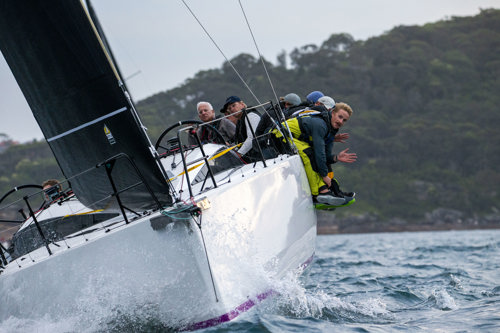
The Bacchanal crew hiking hard in the 2024 Cabbage Tree Island Race. Image: CYCA/Ashley Dart
Is Bacchanal's navigation station more or less comfortable compared to the bigger yachts you've raced on?
Alex: It’s not as good. It’s on one side of the boat, so you’re quite limited. You don’t really want to sit to leeward the whole time. Whereas on the bigger boats, you’re generally down aft, under the cockpit, out of the way. So, Bacchanal’s set up is a bit more challenging.
What is the ideal forecast for this boat?
Steve: Hard up wind would be good and light reaching. I’m hoping, when this gradient settles down, we’ll be in a position where the TP52s won’t be able to plane and get away from us.
Alex: I’m still trying to work it out. The boat’s still quite new. It’s only done 16 or so days sailing. I think reaching will benefit us. Anything with the breeze. We’re pretty happy with the forecast, unless it starts dropping off too much or we get stuck in a wind hole somewhere.
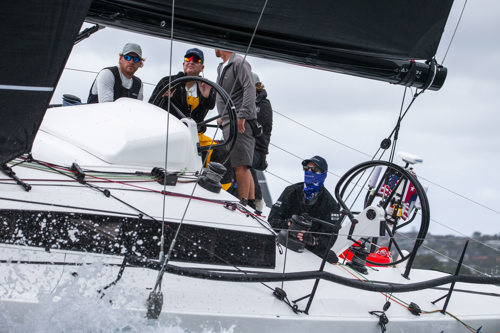
Ronald Epstein behind the wheel of Bacchanal. Image: CYCA/Ashley Dart
Goals for the race?
Alex: To do as well as we can. To get a [top] divisional result and then an overall result following that.
What do you like and dislike about the NSGCYR?
Alex: It’s a good challenging race, especially for the navigator because you’ve got a lot of current and the land effects on the wind and so on.
It can be a bloody cold race. That’s the worst bit about it.
Steve: Specifically for this iteration of the race – the forecast is for quite a lot of snow over the weekend in the Snowy Mountains. So, this low-pressure system associated with the cold front is going to be very, very cold. Nighttime temperatures might drop down to between one and three degrees at times. I’ve made the crew very aware of that.
The positives of the NSGCYR – it’s traditionally the race that brings everyone back together again. Each year there’s a great turnout for this race because it kicks off the season, and what a way to do it. You end up in a fantastic location and it feeds into further racing up the coast.
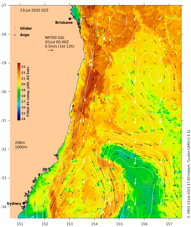
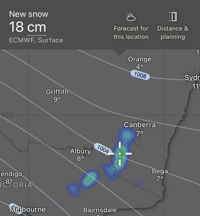
Image 1: Satellite data sea surface temperatures and current direction drawn over.
Image 2: Predicted snowfall from 24hrs to race start.
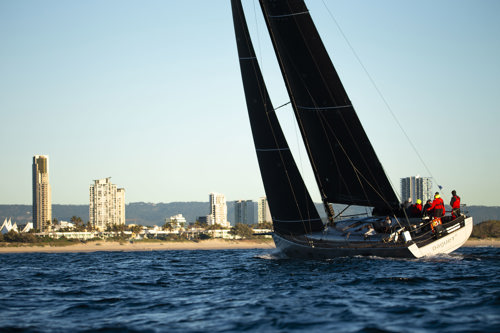
Gold Coast here we come! Image: CYCA/Ashley Dart
TERMINOLOGY*
Featured image credits – Carlo Borlenghi/ROLEX, Ashley Dart/CYCA, Maria Muina/Team Telefonica
/media/3450488/hh_rshyr_performance_ads_970x300px.jpg)